
Eco-friendly printing for designers is no longer optional in 2026. Designers working with physical products are now expected to understand paper, ink, and packaging choices—not just visual aesthetics
Sustainable printing is a production decision, not a visual style.
What Eco-Friendly Printing Actually Means
Eco-friendly printing for designers means reducing environmental impact without compromising print quality, readability, or durability.
This guide focuses specifically on eco-friendly printing for designers who work with real print production, packaging, and sustainable materials.
Choosing Eco-Friendly Paper (What Actually Works)
Recycled vs FSC-Certified Paper
Designers often confuse the two. They are not the same.
| Paper Type | Best Use | Notes |
|---|---|---|
| Recycled Paper | Inserts, flyers, packaging | Slight texture, color variation |
| FSC-Certified Paper | Premium prints, branding | Consistent quality, responsibly sourced |
Organizations like Forest Stewardship Council set the standard for responsible paper sourcing.
Direct rule:
Choose paper based on the project—not ideology.
Uncoated Paper Performs Better Than You Think
Uncoated and kraft-based stocks:
- Use fewer chemicals
- Reduce glare
- Print more naturally with minimal ink
This is why eco friendly paper is increasingly used in U.S. packaging and small-batch print runs.
Eco-Friendly Ink (What Designers Should Know)
Soy-Based and Water-Based Inks
Eco friendly ink does not mean “zero impact.” It means lower toxicity and easier recycling.
What works:
- Soy-based inks for paper products
- Water-based inks for packaging
Standards and color references still rely on Pantone, even in sustainable workflows.
Direct clarity:
Using fewer inks matters more than using “green” inks.
Smart Packaging Tips That Reduce Waste
Kraft Paper Wrapping as a Design Choice
Kraft paper wrapping is not a downgrade. When designed correctly, it:
- Reduces material layers
- Prints well with black or single-color ink
- Feels honest and tactile
This approach aligns with modern sustainable print design practices.
Design for Smaller Print Runs
Overproduction is one of the biggest sustainability failures.
Smart packaging tips:
- Design modular packaging
- Avoid unnecessary finishes
- Plan scalable layouts
What Designers Should Stop Doing
❌ Using full CMYK when one color works
❌ Adding coatings “for luxury” without purpose
❌ Treating sustainability as a marketing claim
Direct truth:
The most sustainable print is the one you don’t overproduce.
Real U.S. Market Examples
In the U.S., independent brands and small businesses:
- Prefer simple, recyclable packaging
- Accept natural paper variation
- Value transparency over perfection
Eco-friendly printing is now a business expectation, not a niche.
My Personal Experience (Busho Designer Insight)
From my own work at Busho Designer, I’ve learned this clearly:
Real experience:
Designs using uncoated paper and limited ink consistently print better, cost less, and create fewer production issues than “over-designed” eco concepts.
I test all printable designs using Adobe Illustrator and export with print-safe settings before publishing any product.
Reduce Waste Before You Print
Good file preparation is one of the most practical ways to make printing more sustainable because it helps prevent avoidable reprints. For packaging and other production files, check bleed, image resolution, color settings, and printer specifications before sending artwork to production.
- Use the printer’s required bleed and safe-area settings.
- Export to the PDF standard requested by the printer, such as PDF/X-4 when appropriate.
- Keep total ink coverage within the printer’s production limits.
- Use short digital print runs when demand is uncertain instead of overproducing inventory.
Practical Steps Designers Can Apply Today
- Reduce ink usage before changing ink types
- Choose paper first—design second
- Avoid coatings unless functionally required
- Test one physical proof before scaling
Quick Comparison Table
| Choice | Eco Impact | Print Quality |
|---|---|---|
| Uncoated Paper | ✅ Low | ✅ High |
| Heavy Coating | ❌ High | ⚠️ Mixed |
| Limited Ink | ✅ Low | ✅ High |
| Decorative Effects | ❌ High | ❌ Risky |
Eco-friendly printing for designers is about making smarter material and production decisions, not adding eco labels to poorly planned designs.
File Prep That Reduces Reprints and Waste
Sustainable printing starts before the file reaches the printer. Poor file preparation can cause reprints, extra material use, and wasted ink. Use the printer’s required bleed, export a print-ready PDF such as PDF/X-4 when requested, keep total ink coverage within the printer’s limits, and avoid unnecessary upsampling or oversized files.
- Set bleed correctly for the printer and packaging format.
- Use the lightest paper weight that still protects and presents the product properly.
- Choose digital short runs when demand is uncertain instead of overprinting.
- Use fewer colors and finishes when they do not add functional value.
Tools for More Sustainable Print Workflows
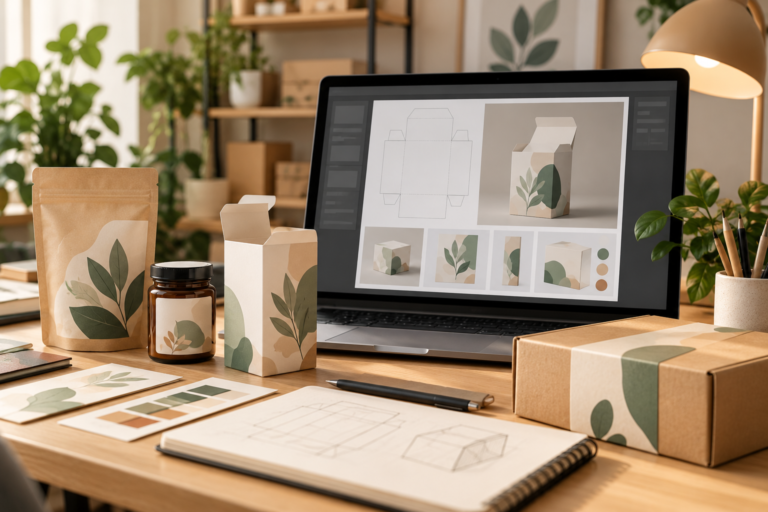
For small-business packaging work, the most useful tools are the ones that reduce reprints and setup errors. Adobe Illustrator is useful for dielines, bleed, vector artwork, and print-ready PDFs, while Photoshop is better suited to image correction and soft-proof preparation. For short-run validation, digital printing can also reduce the risk of committing to large quantities before a design is proven.
If your packaging includes recycling, compostability, or other environmental claims, review the Sustainability Symbols in Packaging guide before adding symbols to your artwork.
FAQ – Eco-Friendly Printing for Designers
1. Is eco-friendly printing more expensive?
Not when designs use fewer materials and simpler processes.
2. Does eco friendly paper reduce print quality?
No—when chosen correctly, it improves readability and texture.
3. Are eco friendly inks mandatory for sustainable design?
No. Reducing ink usage has a bigger impact.
4. Is kraft paper suitable for premium brands?
Yes, when paired with strong typography and layout.
5. What’s the biggest sustainability mistake designers make?
Overdesigning and overproducing.
Want practical examples of sustainable packaging in action?
👉 Read Print Design Trends & Inspiration: What Actually Works in 2026